Eisenhower dollar: $0.327 in metal
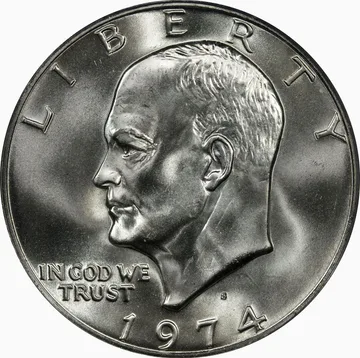 Front1974-S Eisenhower dollar (type coin shown)
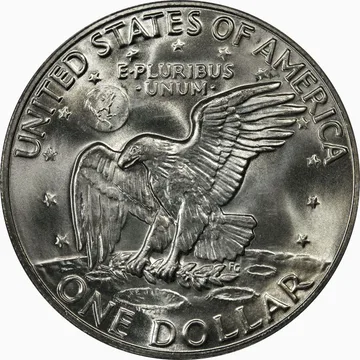 BackSame coin type
The Eisenhower dollar (1971 to 1978) is a large coin you will usually find in clad copper-nickel, which holds about $0.327 of metal at current prices. The 40% silver versions were sold only to collectors, and a 40% silver Ike holds 0.3162 troy ounces of silver. Copper is $6.46 per pound today.
Melt value is the metal only. It is not what the coin sells for: collectors pay for date, mint mark and condition. This page does not show collector prices. Price guides: PCGS, NGC.
Silver Ike melt value: $16.42 in silver
A 40% silver Eisenhower dollar (1971-S to 1974-S and 1976-S, collector issues) is 40% silver and 60% copper: outer layers of 800 parts silver and 200 parts copper over a silver-copper core. It weighs 24.592 g and holds 9.837 g of pure silver, which is 0.3163 troy ounces (24.592 g × 40%). Silver spot from gold-api.com: $51.90 per troy ounce (Live · updated 21:45 UTC).
| Amount | Melt now |
|---|---|
| One coin | $16.42 |
| $5 face value | $82.08 |
| $10 face value | $164.16 |
| $20 face value, one roll of 20 | $328.31 |
Public Law 91-607 (section 201) sets this dollar at 1.500 inches, 24.592 grams in all, with 9.837 grams of silver and 14.755 grams of copper. Clad proof Ikes also carry an S mint mark, so the S mark alone does not settle it: weigh the coin. A silver Ike is 24.59 g; a clad Ike is 22.68 g and worth face value. Sources: Public Law 91-607, section 201 (84 Stat. 1768-1769).
Eisenhower Dollar: weight, size and metal
| Version | Weight | Metal in one coin | Metal value now |
|---|---|---|---|
| Clad (circulation and clad proofs)Outer layers 75% copper, 25% nickel over a copper core: 91.67% copper, 8.33% nickel overall | 22.68 g | 20.79 g copper, 1.89 g nickel | $0.327 |
| 40% silver clad (collector issue)Outer layers 80% silver over a core of 20.9% silver: 40% silver, 60% copper overall | 24.59 g | 9.836 g silver (0.3162 oz t) | $16.41 |
Designer: Frank Gasparro. Edge: reeded. Mint mark: On the obverse, below Eisenhower's bust. Philadelphia coins have no mint mark. Metal in one coin = weight x the metal's share; metal value = grams ÷ 453.59 grams per pound, times the copper and nickel prices. Nickel has no free live feed, so the nickel price is an editorial estimate.
What a group of Ike dollars is worth in metal
| Coins | Clad | 40% silver clad |
|---|---|---|
| 1 | $0.33 | $16.41 |
| 10 | $3.27 | $164.14 |
| 100 | $32.71 | $1,641.38 |
| 1,000 | $327.12 | $16,413.85 |
Metal value at the live price, before any dealer discount and with no collector premium. The face value of 100 coins is $100.
Eisenhower Dollar dates collectors look for
| Date | Why it matters |
|---|---|
| 1973 and 1973-DSold in sets: 1,769,258 each (2,000,000 struck at each mint, 230,742 melted) minted | Not released for circulation. They were meant for Mint sets; the unsold coins were melted, and some coins turned up in change. |
| 1776–1976 Type I vs Type IIType I 4,019,000 (P); Type II 113,318,000 (P) minted | Two reverse dies for the Bicentennial design. Type II has narrower, sharper lettering. Type I is far scarcer. |
| 1972 Type I, II, III (Philadelphia)75,890,000 (all types together) minted | The 1972 Philadelphia dollar has three die varieties, based on how the Earth appears under the eagle. |
| 1971-S to 1974-S silver Ikes1.8 million to 6.9 million each minted | Same date as clad coins but 40% silver. Check the S mint mark and the weight (24.59 g). |
Mintages are the figures in the sources listed below. This page does not list collector prices.
Eisenhower Dollar mintage by date and mint
Clad dollars struck for circulation 16 rows
Dollars dated 1973 were not struck for circulation; the 1973 and 1973-D pieces went into Mint sets. 1975 coins carry the double date 1776–1976 (Type I and Type II are two reverse die types; Type II has narrower, sharper lettering).
| Date and mint | Mintage |
|---|---|
| 1971 | 47,799,000 |
| 1971-D | 68,587,424 |
| 1972 | 75,890,000 |
| 1972-D | 92,548,511 |
| 1973 | 1,769,258 |
| 1973-D | 1,769,258 |
| 1974 | 27,366,000 |
| 1974-D | 45,517,000 |
| 1776–1976 Type I | 4,019,000 |
| 1776–1976-D Type I | 21,048,710 |
| 1776–1976 Type II | 113,318,000 |
| 1776–1976-D Type II | 82,179,564 |
| 1977 | 12,596,000 |
| 1977-D | 32,983,006 |
| 1978 | 25,702,000 |
| 1978-D | 33,012,890 |
40% silver, uncirculated ("blue Ike") 5 rows
| Date and mint | Mintage |
|---|---|
| 1971-S | 6,868,530 |
| 1972-S | 2,193,056 |
| 1973-S | 1,883,140 |
| 1974-S | 1,900,156 |
| 1976-S | 4,908,319 |
40% silver, proof ("brown Ike") 5 rows
| Date and mint | Mintage |
|---|---|
| 1971-S | 4,265,234 |
| 1972-S | 1,811,631 |
| 1973-S | 1,013,646 |
| 1974-S | 1,306,579 |
| 1976-S | 3,998,621 |
Clad proofs (S mint) 6 rows
| Date and mint | Mintage |
|---|---|
| 1973-S | 2,760,339 |
| 1974-S | 2,612,568 |
| 1776–1976-S Type I | 2,845,450 |
| 1776–1976-S Type II | 4,149,730 |
| 1977-S | 3,251,152 |
| 1978-S | 3,127,781 |
About the eisenhower dollar
The Eisenhower dollar was authorized in late 1970 after President Eisenhower died in 1969. It was the first US dollar coin since the Peace dollar ended in 1935. Congress settled a dispute over its metal by ordering clad copper-nickel dollars for circulation and 40% silver dollars as collectibles.
The coin never circulated much outside Nevada casinos. Many were kept as souvenirs. The Mint dropped the design in 1978 and replaced it with the smaller Susan B. Anthony dollar in 1979. The Bicentennial coins dated 1776–1976 carry a Liberty Bell and the Moon on the reverse, a design picked in a public contest.
What the sources say
- Rule CoinWeek says the Coinage Act of July 23, 1965 specified that no new silver dollars could be coined for five years, after which the need for the denomination would be reevaluated.
- Specification CoinWeek says silver-copper clad Eisenhower dollars for collectors were also approved, with the same composition as the 40% silver Kennedy half dollar produced from 1965 through 1970.
- Design CoinWeek says Gasparro's reverse for the Eisenhower dollar is directly inspired by the Apollo 11 insignia, which was originally designed by astronaut Michael Collins.
- Design Stack's Bowers says that for the bicentennial in 1976 the coin received a new reverse picturing the Liberty Bell and the moon, and a dual-dated 1776-1976 obverse.
Sources for these notes
CoinWeek: “The Coinage Act of July 23, 1965, specified that no new silver dollars could be coined for five years, at which time the need for the denomination would be reevaluated.”
CoinWeek: “Silver-copper clad dollars for collectors, the same composition as that used for the 40% silver Kennedy Half Dollar produced from 1965 through 1970, were also approved.”
CoinWeek: “Gasparro’s reverse motif for the Eisenhower dollar is directly inspired by the Apollo 11 insignia; it was originally designed by astronaut Michael Collins”
Stack's Bowers: “For the bicentennial in 1976, the coin received a new reverse picturing the Liberty Bell and the moon, and a dual-dated obverse (1776-1976) as seen on both the quarter and half dollar.”
Quick answers
How much is an Eisenhower dollar worth in metal?
A clad Eisenhower dollar (22.68 g, 91.67% copper and 8.33% nickel) holds about $0.33 of copper and nickel at current prices, far less than its $1 face value. A 40% silver Ike holds 0.3162 troy ounces of silver.
How do I know if my Eisenhower dollar is silver?
Only coins with an S mint mark dated 1971 to 1974 and 1976 can be silver, and they came in blue (uncirculated) or brown (proof) Mint packaging. A silver Ike weighs 24.59 g; a clad one weighs 22.68 g. The silver-clad coins have a lighter edge without the copper stripe of the clad ones.
Are Eisenhower dollars worth more than face value?
Most circulation strikes are common. Silver-clad coins are worth at least their silver. Melt value only measures the metal; collector value depends on the date, mint mark and condition, which this page does not price.
Why are there no 1975 Eisenhower dollars?
Dollars struck in 1975 and 1976 carry the double date 1776–1976 for the Bicentennial, so no coin is dated 1975.
Silver dollar valueSilver dollar melt calculatorSusan B. Anthony dollarMorgan dollar
Sources: Eisenhower dollar (specifications, composition, mintages (citing R.S. Yeoman, A Guide Book of United States Coins), varieties). Photo: 1974-S Eisenhower dollar (type coin shown), Brandon Grossardt (photograph), Frank Gasparro (design). Public domain. Facts checked 2026-10-30. Metal prices: Lustre market data (gold-api.com feed).
